

body horror
on excavating a long-held fear

I’ve never been a fan of horror movies. I watched the usual ones in the 90s as a kid, Children of the Corn, Poltergeist, Halloween, Freddy Krueger, the Exorcist. And they definitely scarred me. I simply don’t have the disposition for horror. I’m jumpy. I’m the kind of person that if someone walks up and makes their presence known in my peripheral vision before they tap my shoulder, I still startle.
I even jump at thrillers.
But since my life has changed so much in the past 6 years, and I don’t mean the simple kinds of changes, like I started a yoga practice or I journal more, I mean people have died and my entire identity has shifted — some of my old fears have been excavated.
Kind of like the idea of an earthquake kicking up parts of the earth that had previously been uncovered and revealing an entire new civilization that we weren’t aware of, like when Domenico Fontana was digging an underground aqueduct in 1592 and discovered the ancient walls of Pompeii adorned with paintings that had been buried since the eruption of Mount Vesuvius in 79 AD. It’d been there all along, but something shifted in the culture, in the action, in the environment and new things revealed themselves.
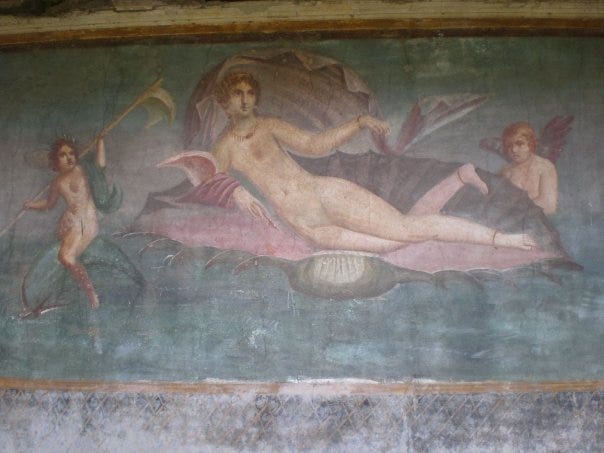
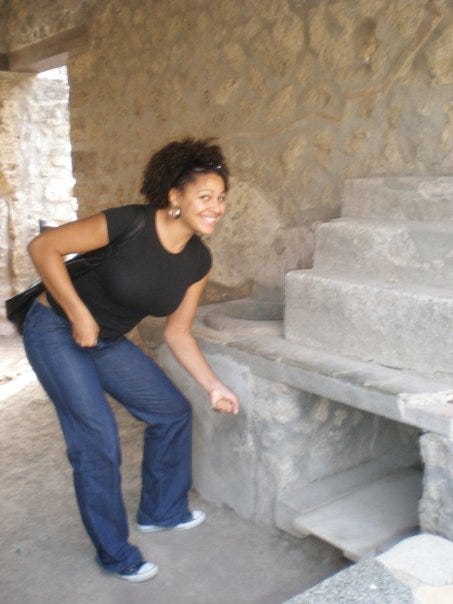
I am, sometimes, my very own Pompeii.
As a result, I’ve felt a draw to explore my deeply held beliefs, and specifically, my deeply held aversions. I’m not going to even call them fears, but when someone brought up a horrotr movie to me anytime over the past twenty years, I invariably shook my head vigorously and sand “mmhnnn nah, I’m not gonna watch that.”
Two years ago, my dearest friends — true horror fans — suggested I try watching a horror movie as a girls’ night activity. Safety in numbers, they proclaimed. And I agreed, but then chickened out. Even if there are people watching it with me, the fear that hits me from a horror movie comes after the movie. In the creaks of the floor, the sound of the dishwasher running, a breeze coming in through the window. All signs that the scary guy or paranormal thing in the film is definitely, most certainly, coming to kill me.
Then last Halloween, I finally agreed and followed through. I think it’s interesting that we can often agree to do something, but that’s not the actual thing, doing the thing, is the actual thing. I felt a relief at the agreement stage and then immense fear when it came time to follow through. It’s one of life’s weirdest and most universal delayed reactions. Like when you agree to go skydiving and then are suddenly staring out the side of an airborne plane expected to jump into thin air.
But I did it, I hosted a movie night with my girlfriends and we watched a pretty tame movie, What Lies Beneath starring Harrison Ford and Michelle Pfeiffer. It was terrifying, yes. I jumped and screamed as I expected. But truly, really, it wasn’t so bad. I mean, the experience wasn’t bad. The movie wasn’t amazing, to be honest.
Sometimes as I’m moving through my life, a thought will pop into my head that eventually travels into my body and becomes something of a motor, driving me forward toward a specific area of curiosity. Horror became that thing for me. I went to a lecture on horror put on by Lectures on Tap where a professor and expert on horror talked about how horror is really about the uncanny, the fear that arises when something is simultaneously familiar and alien. The feeling of the almost known that unsettles the nervous system. We experience it as reality slipping just enough out of alignment to trigger something in us, an unease. It’s not the jump scare that makes horror truly terrifying, it’s the doll that looks just human enough to make our skin crawl.
The concept was famously theorized in Sigmund Freud’s 1919 essay, The Uncanny, where he argues that when the uncanny emerges, it means that something once familiar (but psychologically repressed) returns in distorted form.
In other words, the familiar becomes strange when unconscious material resurfaces in our perception or imagination. That chills up the spine feeling.
After my lecture experience, my fear of horror started to morph into a curiosity. Why was I so afraid of experiencing the uncanny? The professor talked about how we go see horror films because there is something deeply human about seeing our darkest parts (the collective “our”) played out on the screen. It’s a similar draw to why we love true crime. Something about the darkest, most repressed, most unacceptable parts of humanity helps us feel…something. Not better, necessarily, but validated, seen, understood. Even if we don’t personally have monstrous urges. Though I’d argue that most of us do have some urge, some desire that we at least categorize as monstrous, even if it’s only because society has taught us so.
Last week, when I was working at the bookstore, a woman came in and asked to put up a flyer for a French film festival she was putting on, the fantasique, which is really another way for saying horror. I said sure! We chatted for a moment and she put up the flyer and left. But I thought about it all evening.
I decided to keep pulling at my horror thread and attend the movie. It was Les Yeux Sans Visage (Eyes Without a Face), a 1960 film directed by Georges Franju.
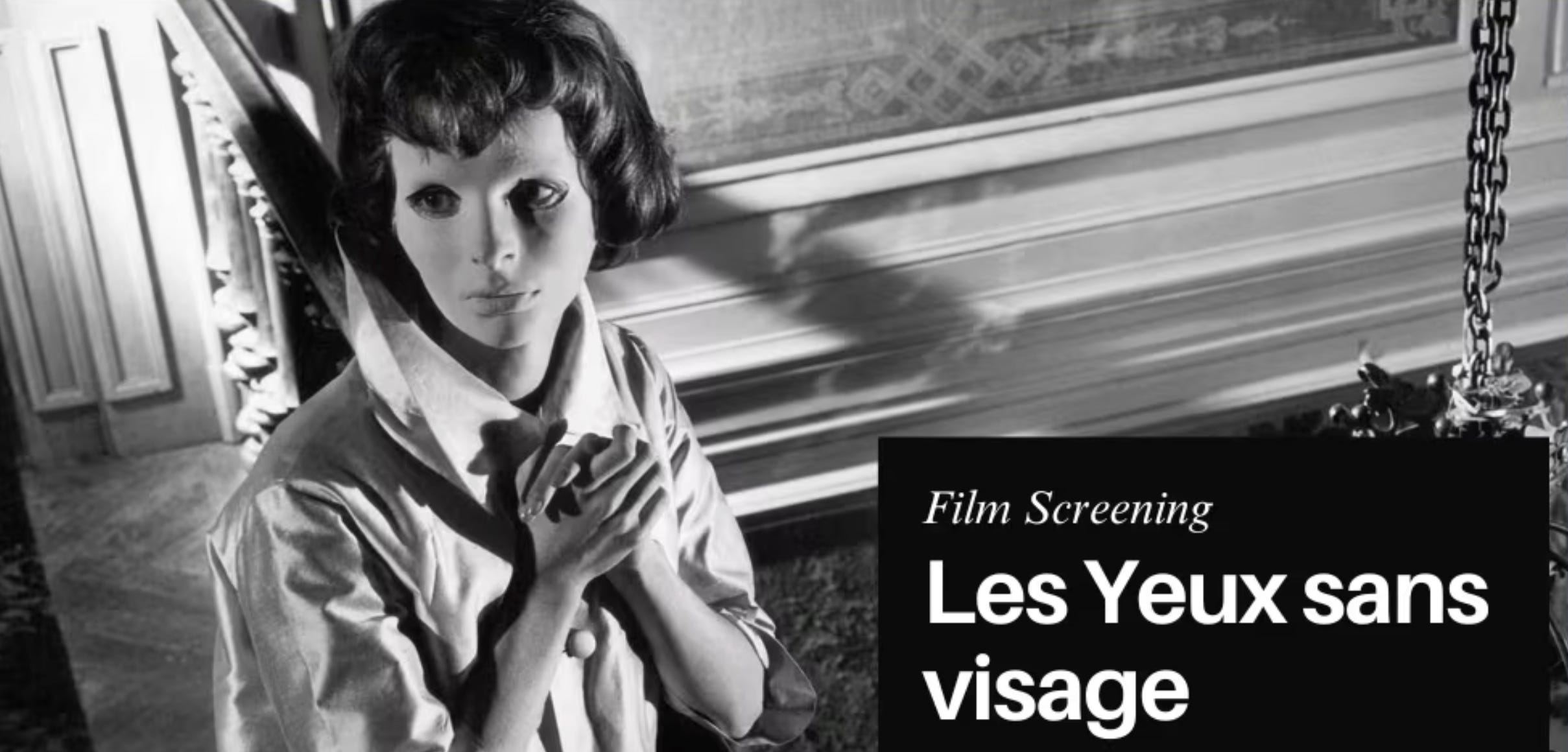
The film was put on at the Alliance Française Chicago, who hosts francophone cultural events and screens movies in their small theater. Maybe it was the intimacy of the space (it was a Monday night and only about 15 people were in attendance), or maybe it was the enthusiasm the host had for the movie, but I was more excited than scared.
The film was shattering. The soundtrack was either too upbeat for such a dark film, or it was silent and all you heard was the steps of the characters in a creepy house, or the motor of a car. Or the slicing of a scalpel. The film centers around a doctor whose daughter is in a horrific car accident and loses her face, but her eyes are intact. She wears a mask as her father commits unspeakable acts to try to fix her. The mask renders her doll-like, made only more palpable by the disquieting body acting of Édith Scoub. The sociopathy is chilling. The characters so well done. The body horror scenes so clinical and detached. The uncanny alive and well. I loved it.
The fantastique, as described by one of the hosts of the festival is (and I’m paraphrasing), “kind of like that feeling you get when you wake up in the middle of the night from an unsettling dream and there is a moment when you’re not sure if you’re awake or sleeping, you’re not sure what phase of consciousness to trust.”
Now that I understand horror, I think I might be hooked on it. Perhaps I was simply afraid of the unexplored parts of myself, not finding comfort with the fear because I was calling it fear instead of what it actually was: psychic discomfort. The feeling of seeing a part of myself exposed, of feeling tickled by the nightmare playing out before me. The feeling of release from being in danger without actually being in danger.
Sometimes the unexplored parts of ourselves are exactly the parts we must prioritize in our exploration. You never know what you’ll uncover.
As someone who prefers not to watch horror films, but can binge watch a season of Criminal Minds, I’m tracking your historical, philosophical, and personal evolution with horror films.
I’m someone who doesn’t find pleasure in being afraid. In the past, it was due to having lived experiences where my life was literally in danger. And now, it’s a preference born from a soothed nervous system that I’ve been fiercely protecting over the last 12 months.
However, reading your perspective and experience does bring up a new question for this new me: can I leave room for experiencing life if I’m guarding myself from human emotions, such as fear? Where dos the balance live?
That’s not a question to be answered today; but now it has language.
You’re a great writer and this was a compelling read.
Hi Arit, I’m on the opposite end of the spectrum. Loved horror and thriller since I was 13 (probably wasn’t supposed to, but here we are) and always thought it was just my need for adrenaline — or maybe a nervous system that’s always been in flight mode.
Still going strong. Girls’ horror night at my place at least once a month, paused briefly while pregnant, now back in full force.
I think horror is actually the purest escapism — the horror in the news is genuinely scarier than Longlegs. And maybe that’s exactly why you’re less scared now. Real life has raised the baseline. A movie can’t excavate what life already has.
Love your writing, and I deeply relate to being our own Pompeii 😄